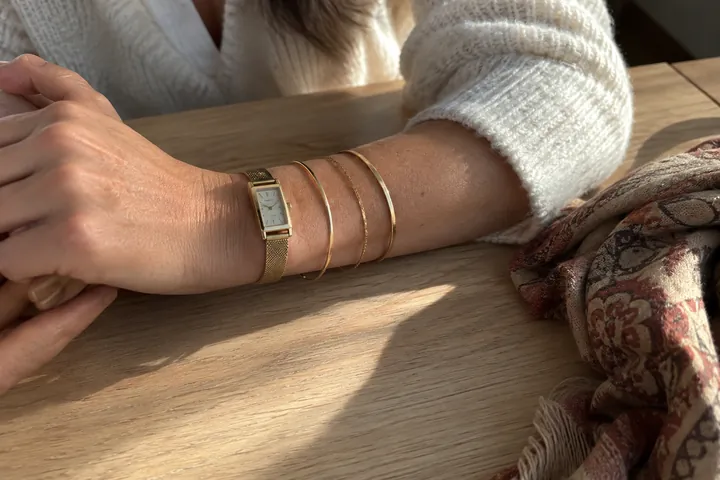
Why stacking works
A stack of bracelets is one of the easiest ways to add interest to a plain outfit. It is also one of the easiest ways to look cluttered. The difference lies in a few decisions that most people make by instinct: how many pieces, which metal, which widths and where the watch sits.
Once you know the rules, you can build a stack in under a minute and change it to suit the day.
Rule one: keep the metal in one family
Mixing gold and silver on the same wrist is not forbidden, but it is harder to make look deliberate. The most reliable approach is one metal family, with variations in colour and texture. Warm yellow gold, rose gold and brushed gold sit together well. Silver, platinum-toned and steel form another family.
If you already own pieces in two metals, use one as the main stack and the other as a single accent on the opposite wrist.
Rule two: vary the widths
A stack looks more expensive when the widths differ. A wide cuff or a solid bangle works as the anchor. Thin chain bracelets, slim bangles or a fine cable sit around it. Three widths is enough. Four pieces of identical width look like a set of hair ties.
Start with the widest piece closest to the hand. Add the thinner pieces above it, toward the elbow. This keeps the stack from sliding down and puts the most visible piece where people look.
Rule three: keep the count low
Three or four pieces is the working range for everyday life. Five or more start to clink on keyboards and catch on knitwear. If you like a larger stack, wear it on a day with fewer sleeves to think about, or reduce the number of thin pieces.
Rule four: decide the watch first
A watch changes the whole arrangement. If you wear one, place it on the wrist you look at most, usually the left, and stack the bracelets on the other hand or above the watch band. A thin watch on a mesh band pairs well with two or three bangles. A chunky watch works better with one wide cuff.
If you do not wear a watch, use the wrist you prefer and let the stack run from the wrist to just below the elbow on sleeveless days.
Rule five: match the stack to the clothes
Gold stacks look best with warm neutrals, camel, cream, navy and olive. Silver and steel suit grey, black and blue. Keep the stack lighter with fine knits and light cotton, since heavy pieces pull at the sleeve. Bold or chunky stacks work well with structured jackets and a clean white shirt.
Rule six: keep the stack easy to put on
If you need two hands and a mirror to put the stack on, you will stop wearing it. Choose clasps you can manage one-handed, and check the size before you buy. A bangle should slide over the hand without forcing it. A chain should sit close to the wrist without leaving a mark.
A simple everyday combination
On most days, a good combination is a watch on the left wrist, one wide bangle and two thin pieces on the right. The metal is the same, the widths differ, and nothing rubs the skin. That is the template to start from.
Bracelet stack planner
Interactive toolTell the planner how you wear your jewellery. It gives the rules for your stack.
Loading the result. The guide above works without this tool.
Care for the pieces you wear daily
Bracelets wear faster than necklaces because they touch soap, lotion, sweat and hard surfaces every day. Remove them before washing hands with heavy soap, before swimming in chlorinated water and before applying creams. Store them flat or hung separately so chains do not tangle and plated pieces do not rub against each other.
A stack is finished when nothing on it is trying to get your attention. If one piece keeps catching, remove it.
Frequently asked questions
How many bracelets is too many?
For daily wear, three or four pieces is a comfortable limit. Beyond that, the stack tends to clink and catch on clothing.
Can I mix gold and silver?
Yes, but choose one as the main metal and use the other as a single accent, ideally on the opposite wrist.
Should a watch go under or over the bracelets?
Usually over. Keep the watch on the wrist you look at most, and stack the bangles beside or above it without covering the dial.
How do I stop thin chains from tangling?
Clasp them once before storing, lay them flat in a small box, and keep them apart from the thicker pieces.