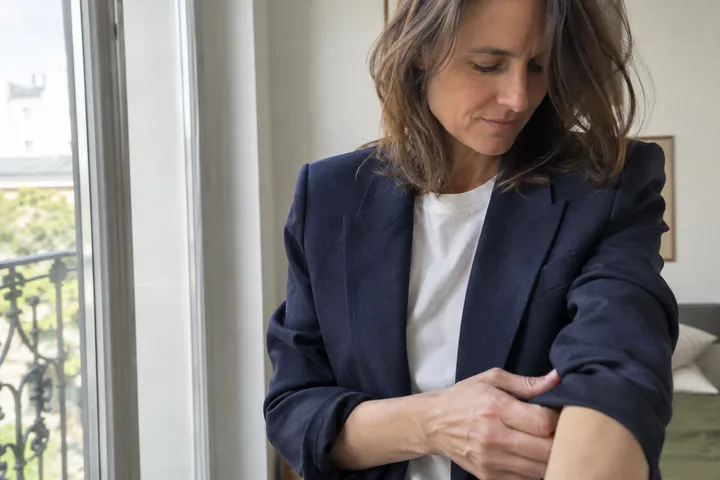
Look at the resting sleeve before its endpoint
Sleeve length concerns where the cuff finishes. Sleeve pitch concerns the orientation of the sleeve and how it hangs around your ordinary arm position. Those are separate questions. If fabric appears to spiral around the arm, shortening the cuff is not automatically the relevant change.
Start with the whole jacket settled on your shoulders. Let your arms rest naturally instead of pulling them into a pose that makes the cloth look smoother. Our shoulder-divot guide focuses on a dent near the sleeve head. Here the focus is the line of the sleeve down the arm, not a diagnosis from a single shoulder hollow.
| Observation | Keep as a separate question | Useful next comparison |
|---|---|---|
| Cuff finishes lower than preferred | Sleeve length | Resting arm with intended shirt |
| Cloth twists around the arm at rest | Sleeve hang and orientation | Both sides from the same viewpoint |
| Fold appears during a reach | Movement | Return to a relaxed stance |
| Fabric peeks below the outer cuff | Identity of the visible layer | Shirt, jacket lining or another layer |
What do tailoring guides mean by pitch?
Articles of Style discusses sleeve pitch as rotation and distinguishes it from sleeve length. Its fitting guidance emphasizes a clean resting drape while allowing movement. Those observations explain why a cuff-length request and a twisting-sleeve request should not be merged into one instruction.
Oliver Wicks relates twisted sleeve wrinkles to the wearer's natural arm position. Union Tailors illustrates sleeve-angle differences in its pattern-alteration discussion. These are tailoring explanations of fit relationships. They do not establish a cause or repair for your jacket from an online photograph.
Make a comparison you can repeat
Wear the shirt or knit you intend to use with the blazer. Smooth an accidentally bunched underlayer gently, then let both garments settle without repeatedly tugging them into place. Keep the same fastening state and empty the jacket pockets. A phone held high can change your arm position; use a timed picture or another person's help for a resting side view where practical.
Note which arm shows the feature and whether it returns after ordinary movement. Keep a front, side and back observation separate instead of combining different poses into one verdict. Do not iron away an unfamiliar fold merely to complete the test. Follow the garment's care instructions and ask about persistent construction questions.
Check what changes when the layer changes
If the sleeve catches over a bulky top, repeat with the intended alternative layer and label the comparison. A difference between a thick knit and a smooth shirt is useful information. It does not prove that all wrinkles came from the underlayer or identify the work needed on the sleeve.
Keep a visible cuff layer separate too. Our sleeve-lining guide helps name what protrudes before discussing length. A lining edge that shows below the cuff and twisting farther up the sleeve may need different questions at the fitting.
Use the wider check without turning it into a repair plan
Blazer fit check
Interactive toolTry the blazer on, then tick each point that is right. Eight points out of eight means the fit works.
Loading the result. The guide above works without this tool.
Record comfortable movement and the rest of the jacket alongside the sleeve observation. A checklist score cannot assess internal construction or available alteration allowance. Compare another cut where possible before buying a jacket that depends on unresolved work. Bring the same underlayer to a tailor and show the jacket at rest as well as after a reach.
Ask two clear questions at the fitting
Describe where you want the cuff to end, then separately describe the twisting you see. Ask what a proposed change affects and what it leaves alone. Do not assume that shortening, removing padding or changing a button will correct the way the sleeve hangs. Our pocket guide also reminds you to assess the jacket with its intended use in mind, rather than from an arranged photograph alone.
Is sleeve pitch another name for sleeve length?
No. Keep the sleeve's orientation and resting hang separate from the position of its cuff endpoint.
Do wrinkles prove that the sleeve needs rotating?
A photograph cannot establish the construction or repair. Record the feature in a repeatable resting stance and ask for a garment-specific assessment.
Should I judge a reaching pose as the resting fit?
Keep the two observations separate. Note what happens during movement and whether the sleeve returns when your arm relaxes.