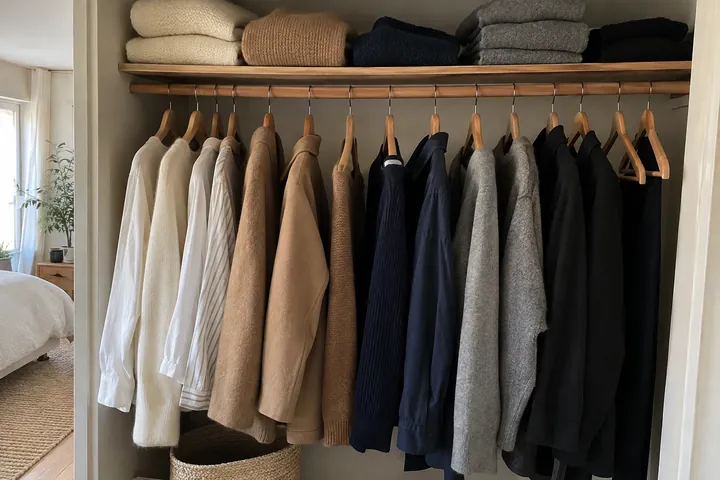
What changes between unlined and half-lined?
The difference is the extent of the interior covering, rather than an automatic ranking of quality. A half-lined jacket covers selected areas; an unlined jacket exposes more of the reverse of its outer fabric and internal finishing. The precise arrangement varies.
That variation matters when shopping online. Suitsupply's jacket guide describes an unlined construction that retains sleeve lining. Moss's explanation includes a shoulder panel in its unlined example. These are descriptions of their garments, not interchangeable promises about every blazer.
Compare the interior coverage
Illustrative examples| Label | Useful check | Not established |
|---|---|---|
| Unlined | Which areas remain covered? | No lining anywhere |
| Half-lined | Where does coverage start and stop? | An exact half by measurement |
| Fully lined | Condition, material and movement | Guaranteed warmth or fit |
Blue marks illustrative lining coverage, cream shows exposed body fabric. These diagrams are not a maker specification or a cutting pattern.
Mostly exposed
Check the reverse outer fabric and the finishing of exposed seams. This example retains sleeve lining; another maker may use a different arrangement.
Partially covered
Identify the actual upper-back and front coverage instead of treating half-lined as a precise measurement. This is one possible arrangement.
Body covered
A visible covering across the body does not establish its fiber, padding, care method or warmth. Read the garment information and check comfort separately.
Use the examples to ask a better question: where is the lining in this jacket? Request an interior photograph when a listing shows only the front. A close-up of a lapel cannot answer a question about the lower back.
Where should you look inside the jacket?
Check four locations separately: sleeves, upper back, lower back and front panels. Open the jacket without forcing it inside out. Note which areas have a distinct covering and where seams remain visible. Do not unpick a seam to find out what lies beneath it.
An exposed seam is not automatically unfinished. The University of Nebraska-Lincoln Extension's construction explanation, published in 1993, distinguishes lining from the finishing needed when internal construction remains visible. Its practical lesson is to inspect the finish, not to reject every visible allowance.
Check for a caught pocket bag or an existing snag too. Record a concern before purchase, and ask the retailer to explain an unfamiliar construction. Our blazer fit guide covers the separate question of whether the garment gives you comfortable movement.
Can an unlined blazer have lined sleeves?
The label can describe the body while the sleeves retain lining. Hugh & Crye's lining guide provides another maker example of that arrangement. Check the sleeves rather than extending the meaning of a body photograph to the entire jacket.
Sleeve lining and the layer underneath work together. Try the blouse, shirt or knit you intend to wear. Slip the jacket on gently, bend your elbows, reach forward and let the sleeves settle again. Notice whether the underlayer bunches or catches. A different combination may feel different even when the blazer size stays the same.
Does less lining always mean a cooler blazer?
Lining coverage alone cannot establish how comfortable a jacket will feel in your conditions. The outer fabric, its construction, the fit, the layer beneath it and the setting also matter. A coverage label supplies only part of that information.
Compare the actual jackets with the same underlayer and ordinary movement. If you cannot try them, check the product's fabric details, interior photographs and return conditions instead of treating an unlined label as a performance guarantee. Neither a natural fiber name nor a synthetic lining name is a complete comfort test.
Is half-lined the same as half-canvas?
Lining and internal structure are different features. Lining is the covering you can often see inside; canvas, interfacing and padding concern other parts of the construction. A reduced lining description does not tell you everything about those layers.
Ask about each feature separately if it matters to your choice. The guide to blazer vents handles another independent detail: the openings at the back hem. Counting those openings does not reveal the amount of lining either.
Which observation should change your next step?
Start with the specific problem, not a preferred label. Choose the observation below that matches what you can actually see or feel; keep the other explanations open until you have checked them.
Choose the next observation
Interior checkThe listing has no interior photograph
Request views of the sleeves, upper back, lower back and front panels before assuming what the label covers.
The sleeves catch on my shirt
Reset both layers gently and repeat the movement. If pressure remains, compare another combination or seek an assessment; do not cut the lining.
I see an exposed seam or pocket bag
Look at its actual finishing and condition. Ask the retailer about an unfamiliar detail instead of treating visibility alone as a defect.
For example, a listing that says half-lined but provides no interior view leaves a coverage question unanswered. Ask for the view. A sleeve that repeatedly catches during a fitting raises a movement question; test the intended layer and ask for help if the cause remains unclear. Those two situations do not call for the same response.
What should you check before travel or cleaning?
Follow the actual care label and inspect the interior before packing. Reduced lining does not automatically make a blazer washable or safe to steam. Keep exposed internal areas away from bag zippers, shoe hardware and other objects that could catch them.
Use the blazer packing guide for arranging the jacket with less pressure. If you find a tear, loose lining or persistent catching, have the garment assessed before treating packing or a change of size as the repair.
Frequently asked questions
Does unlined mean no lining anywhere?
Not always. Some makers retain sleeve or shoulder lining under that description. Inspect the actual interior or ask for photographs.
Does half-lined mean exactly half the jacket is covered?
It describes partial coverage, not a guaranteed measurement. The location and shape of the covered areas vary by garment.
Is an unlined blazer lower quality?
Exposed construction alone does not establish quality. Check its finishing, condition, fit and suitability for your use.
Will a half-lined blazer fit more loosely?
Coverage is not a size measurement. Compare the actual cut and movement with the same underlayer.
Can I remove a lining to make a blazer cooler?
Do not assume it is a simple alteration. Construction and internal finishing differ; ask an alterations professional to assess the actual garment.
Can I wash an unlined blazer at home?
Follow its care instructions. Lack of full lining is not permission to wash the shell, interfacing or other components.