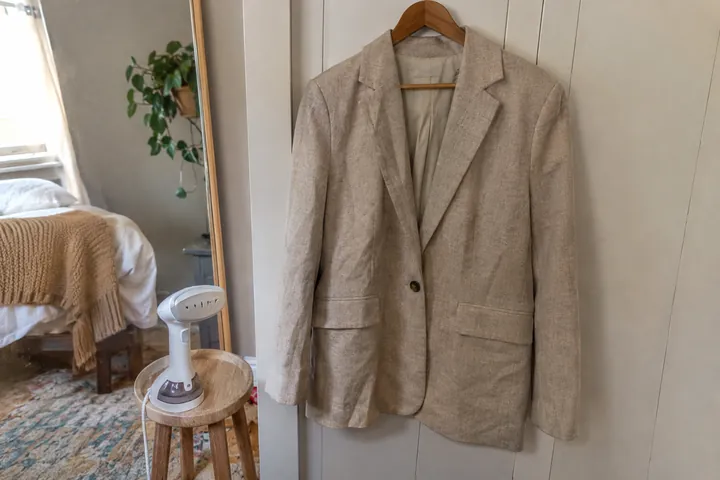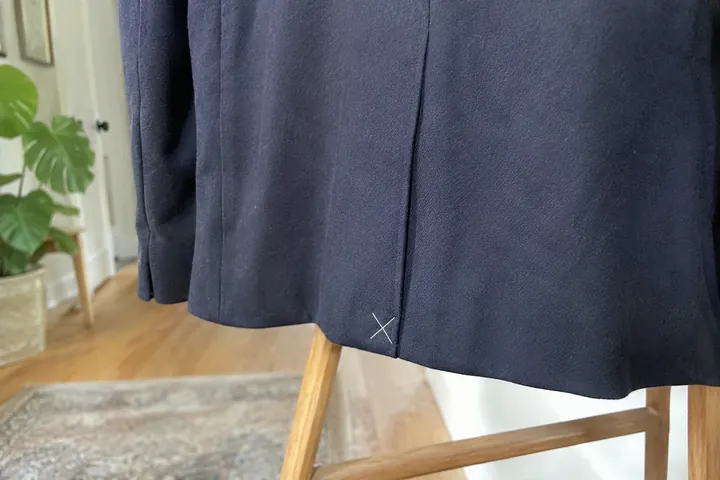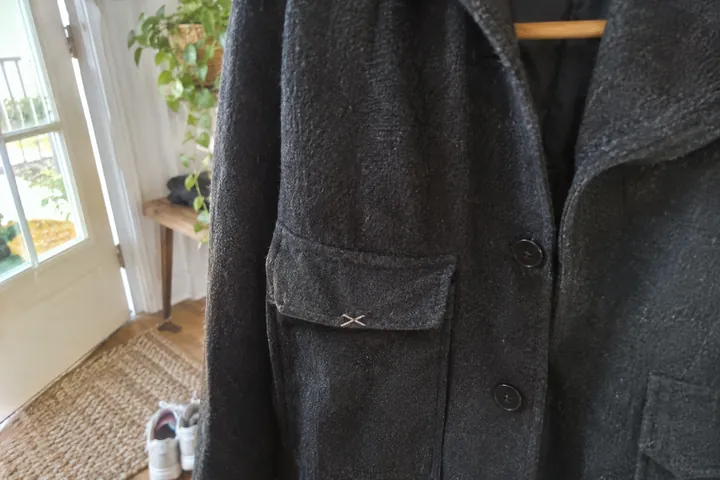
Is the stitch a shipping tack or part of the pocket?
A new coat often arrives with its pockets held shut by a few loose stitches. King & Allen explains that tailors keep pockets closed to protect the garment during the final press and to hold its shape during fitting. SuitShop describes the same practice as tack stitching for manufacturing and shipping.
That explains many closed pockets. It does not prove that every closed pocket on your coat has a bag behind it. Some designs copy the outline of a pocket for the look only, and cutting stitches there leaves a mark or a gap in the cloth.
What should you confirm before you touch a seam allowance?
Work with the coat off your body, on a clean table in good light. You need three confirmations.
- An opening exists. Look for a slit along a welt, under a flap, or at the side of a patch. A line of dense stitching with no gap in the cloth is not a closed pocket.
- A bag sits behind it. Gently feel the lining inside the coat at the same height. A real pocket usually has a second layer of fabric there, often with its own seam. Do not press hard or tug on the lining.
- The thread bridges the opening. A temporary tack is a loose strand crossing a gap, often a small cross or a few long stitches. The permanent stitches that finish the edge of the pocket are short, regular and continue along the cloth.
| What you see | Likely meaning | Next step |
|---|---|---|
| Loose cross or long stitches over a visible slit | Temporary tack | Identify one strand, then cut that strand only |
| Dense, even stitching that follows the pocket edge | Construction stitch | Leave it |
| No slit under the flap | Decorative flap | Do not cut; there is no pocket to open |
| Slit visible, nothing felt behind it inside | Unknown bag | Ask the seller or a tailor |
| Thread disappears into the seam | You cannot trace it | Stop and ask |
What are you looking at?
Before you cutI see a loose cross over a visible slit
Likely a temporary tack. Identify one strand, cut only that strand and check the opening and the pocket bag afterwards.
The stitching is dense and follows the pocket edge
Treat it as construction. Leave it and ask the seller or a tailor if you still need to know.
There is no slit under the flap
The flap may be decorative. Cutting thread will not create a pocket.
How do you cut the tack without marking the wool?
Use a small seam ripper or sharp thread snips, not a kitchen knife. Lift one loose strand away from the cloth with the tip, and cut only that visible strand. Pull the released thread out slowly, keeping the other hand flat on the coat so the cloth does not stretch. If the thread resists, stop. Forcing a strand can pull a loop of yarn from a soft wool surface.
Check both faces afterwards. The flap should lie flat, and the opening should have clean edges. If you notice a snag, smooth it back gently and do not trim it.
Should you open the pocket at all?
Opening is a choice. A coat with closed pockets keeps a cleaner outline on the hanger, and a heavy phone in a coat pocket can pull the front down. If you plan to carry items, open the pocket and test it with the load you actually carry. Compare the front in a mirror with and without the weight, in the same stance. If it hangs differently, the pocket may be better left for light items.
Keep one record of what you did: photograph the pocket before and after, and note which pocket you opened. If you are still deciding whether to keep the coat, check the return terms before removing any stitch.
When should a tailor take over?
Stop and ask when the thread is part of a reinforcing bar, when the lining blocks your view, when the cloth is already nicked or when a stitch will not separate with light pressure. A used coat may have had its pockets closed on purpose, to hide damage or a repair. Look for a mismatched stitch color, a patch inside or a stiff area around the opening, and have that history assessed first.
For the jacket version of this question, see our guide to blazer pocket types and the notes on temporary stitching at the back vent. If the coat still looks wrong on you after the pockets are sorted, move on to the blazer fit checks; a coat can share many of the same fit problems.