Is the hem really uneven, or does it only look uneven on you?
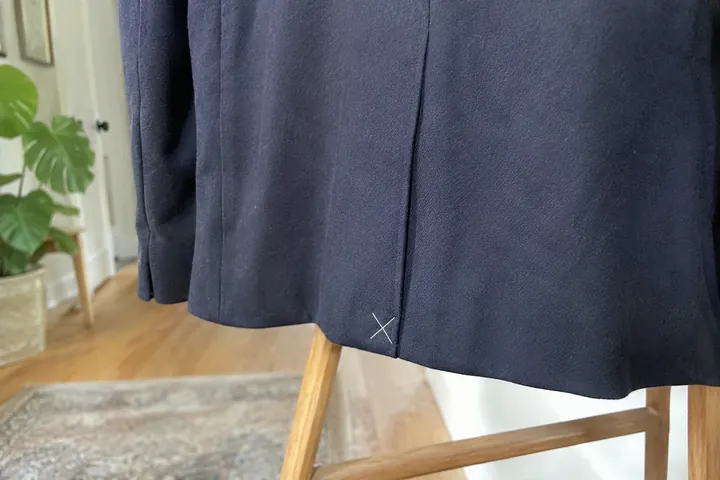
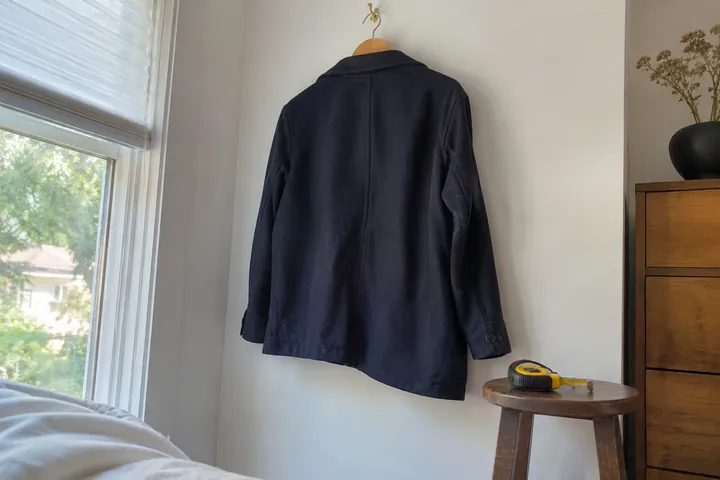
Start by hanging the jacket on a broad, level hanger with the buttons fastened. If the lower edge is level there but dips on one side when you wear it, the cloth is probably not the problem. One shoulder carrying a bag, a hip that sits slightly higher, or a heavy phone in one pocket can all drop a hem by a visible amount. If the edge is still uneven on the hanger, the jacket itself needs a closer look.
Do not trust the mirror alone: you adjust your stance without noticing. Ask someone to take a photograph from the front and one from the back at the same distance, with your arms relaxed and your weight even on both feet.
Which kind of unevenness are you seeing?
| What you see | What it usually means | What to try first |
|---|---|---|
| Hem is level on the hanger, uneven on you | Posture, pocket load or a bag strap | Empty the pockets, stand squarely and photograph again |
| Hem is uneven on the hanger, one side lower | Hanger tilt, uneven hem, or a side that has been pulled by weight | Compare on a second level hanger, then measure both sides |
| Front hem curves up toward the sides by design | A cutaway or curved front, not a fault | Check how the maker shows the model; compare a photo of the same style |
| Back is longer than the front on both sides | A longer back by design, or a sleeve and shoulder pulling the front up | Compare in the layer you actually wear, standing still |
| One side lower only when buttoned | Fastening or a button set off center | Check the button row against the buttonholes before blaming the hem |
How do you measure the difference before talking to a tailor?
Lay the jacket flat, face up, with the center front buttoned and the sides smoothed without stretching. Measure from the bottom of the collar seam at the back, or from a fixed seam such as the underarm, to the hem on each side with the same tape. Write the two numbers down and take the difference. A gap of a few millimeters is within the ordinary variation of cut cloth; a gap you can see in a photograph is worth raising. These numbers describe your jacket, not a standard.
Repeat once with the jacket hanging, since heavy fabric stretches slightly differently flat and hung. If the two results disagree, say so when you ask a tailor.
Can a tailor even the hem?
Often, yes, but the answer depends on what sits above the edge. AD Stitch's alteration guidance describes hem work as tied to pockets, vents and lining, and North Shore Alterations names lining and vent construction as part of it. Evening out the longer side removes length from a jacket that may already be the length you want, so ask which side would be shortened and by how much, and whether the pockets and vent will then sit differently.
If the hem differs because of a stretched side seam or a lining that has pulled, shortening the cloth treats the symptom. Ask for the construction to be inspected first.
What if the unevenness comes from the vent?
A back vent that overlaps unevenly can make one side seem lower. Check whether the vent is closed by a tack stitch before judging; the vent stitch guide explains how to tell a temporary tack from construction, and the single versus double vent guide shows how each type should hang.
A three-photo record to keep
- The jacket on a hanger, from the back, hem in view.
- You wearing it, from the front, in the layer you normally wear under it.
- You wearing it, from the back, with the same stance.
Keep the photos next to your tape measurements. If you later buy another jacket, repeat the same three shots and compare. The whole-blazer fit checklist is a useful companion for the rest of the fit, and our note on a blazer that feels too long explains the other reason people shorten a hem.