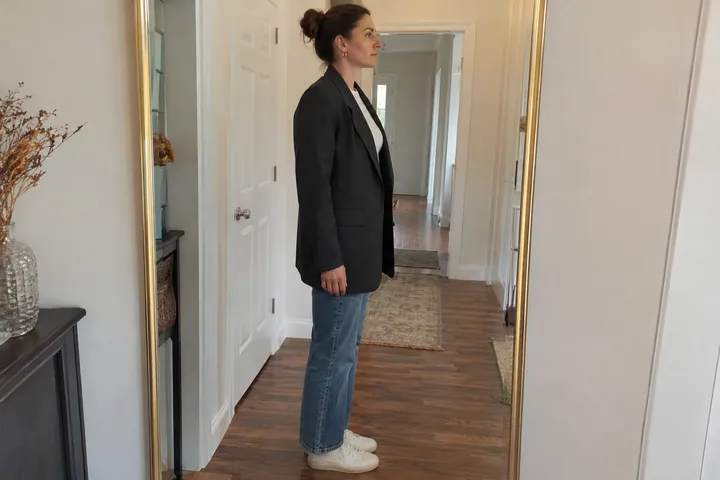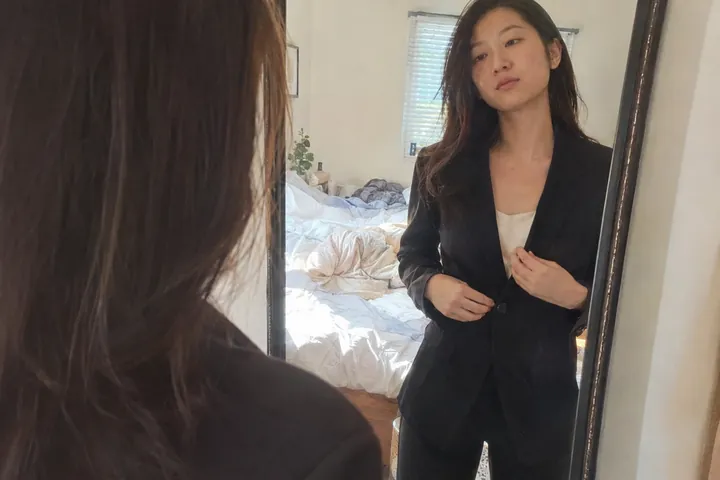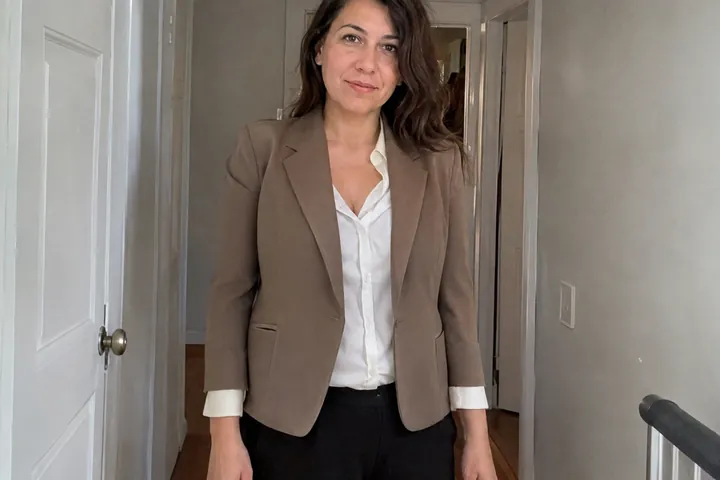
Is the sleeve short by design or short for your outfit?
Look at the retailer's description and product photographs before judging the jacket by a traditional suit rule. Bracelet-length and three-quarter sleeves are meant to expose more of the forearm. That can be a deliberate proportion rather than a sizing fault. The practical question is whether the outline and coverage work for your outfit and intended setting.
Try the jacket over the layer you will actually use. A long blouse cuff can make the same jacket look shorter than it did over a sleeveless top. Keep that observation separate from whether you want more jacket coverage. Our whole-blazer fitting checklist helps keep shoulders, closure and sleeves in the same assessment.
What should you compare with your arms relaxed?
Let the jacket settle without pulling its shoulders down. Stand naturally and look at each wrist separately. Then make an ordinary forward reach and return to rest. Sleeves move during activity; a moving-arm photograph is a different observation from the resting length. Do not hold your arms unusually straight just to create a preferred cuff position.
Use a short fitting note rather than a diagnosis: left cuff location, right cuff location, underlayer, resting stance and movement concern. If the two sides look different, check that one blouse sleeve is not caught inside the jacket. If the difference remains, preserve it in the note for the fitter rather than deciding both sleeves need the same change.
| What you see | Useful next check | What remains unknown |
|---|---|---|
| Both wrists exposed at rest | Intended bracelet or full-length design | Whether extra fabric exists inside |
| Much more blouse visible on one side | Underlayer position, then each arm separately | Whether jacket lengths differ |
| Cuff rises during a reach | Return to the same natural stance | Whether lengthening improves movement |
| Sleeve feels tight and looks short | Compare another cut over the same layer | Which construction change would help |
Can a tailor lengthen blazer sleeves?
Possibly, but availability of hidden cloth matters. Men's Wearhouse explains sleeve lengthening in its alterations guide. Its service guidance is a starting point for questions, not a promise about your jacket. Ask the fitter to inspect the hem allowance and lining and explain how the finished cuff would look.
Button placement and working buttonholes can limit the result. Use our functional and decorative cuff comparison to name what is visible without unpicking anything. Do not buy a short-sleeved jacket assuming a standard amount can always be released. The construction may offer little useful extension, and a previous fold can remain visible.
Why should you avoid borrowing a universal measurement?
Proper Cloth's sleeve-length reference describes its own tailored-jacket system and distinguishes jacket measurements from shirt measurements. Those numbers have different starting points. Comparing them directly can create an apparent shortage that is only a measurement mismatch.
For a relaxed women's blazer, start with the intended design and your preferred coverage. If a retailer supplies a sleeve measurement, ask how it was taken and use the same method on a comparable jacket. The brand's alteration-limit guide also illustrates why construction-specific advice is preferable to a number copied from another garment. No universal extension allowance is established here.
Blazer fit check
Interactive toolTry the blazer on, then tick each point that is right. Eight points out of eight means the fit works.
Loading the result. The guide above works without this tool.
What should your fitting request contain?
Bring the actual blouse and describe the resting coverage you want. Ask whether the lining can accommodate that change, whether buttons would need moving, and whether the old fold could remain noticeable. Ask for an assessment before authorizing work. If the proposed change creates a cuff arrangement you dislike, compare another cut instead.
A fictional note might read: both sleeves end above my preferred point at rest, the right blouse cuff is longer, and ordinary reach is comfortable. That gives the fitter three separate observations. It does not preselect an alteration or instruct them to make the sides identical without checking the wearer.
If body length is also a concern, use the blazer body-length comparison. A jacket can have a long body and deliberately short sleeves. Altering one does not automatically improve the other.
Does exposed wrist always mean the blazer is too small?
No. Check whether the design is bracelet-length, then assess closure, shoulders and movement in the intended outfit. Wrist exposure alone does not establish the size.
Can every short sleeve be let down?
No. A fitter needs to inspect the available cloth, lining, cuff and buttonholes. A visible folded edge does not guarantee usable extra length.
Should both sleeves be changed by the same amount?
Have each side assessed on the wearer with the intended underlayer. Do not assume equal changes from an uneven blouse cuff or one photograph.