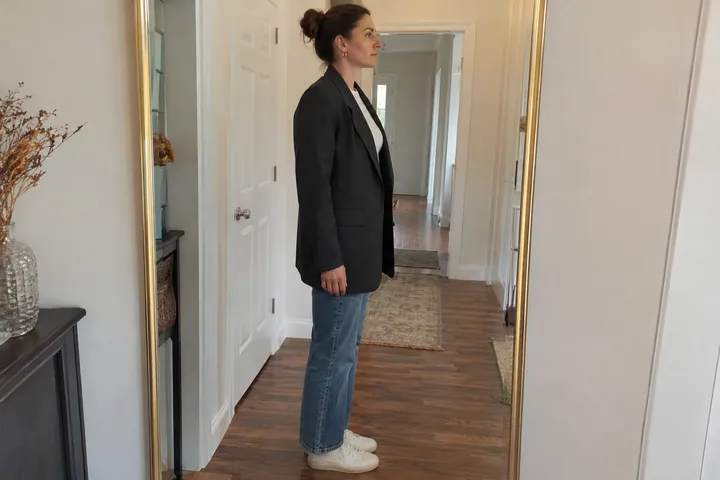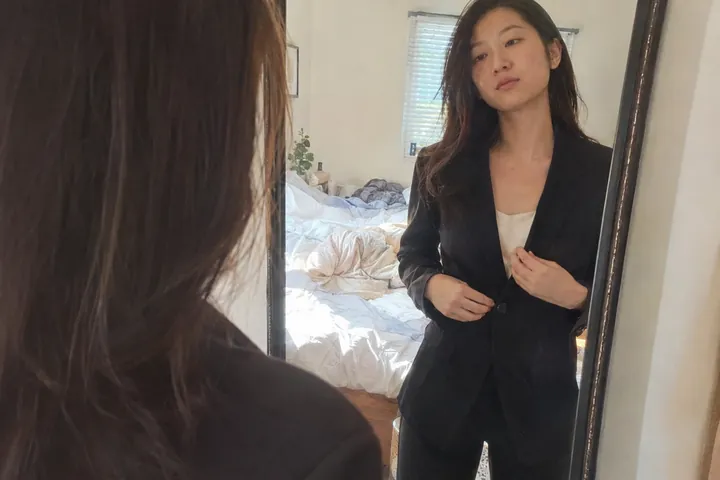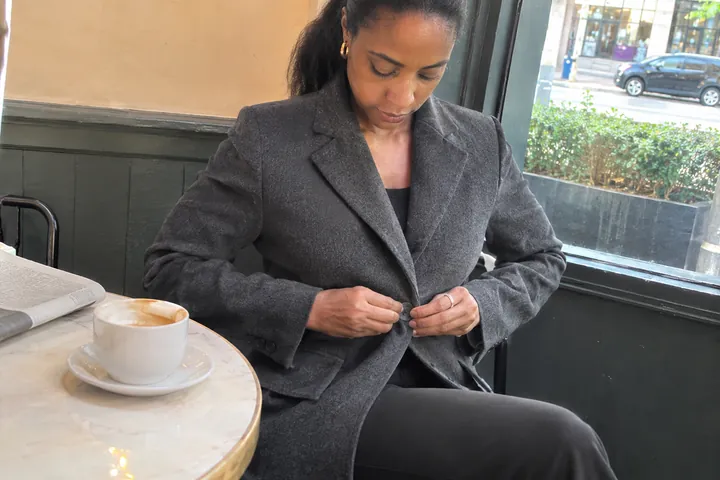
First locate the fullness you want to change
Look at the upper arm, elbow and wrist separately. Fullness throughout the sleeve is a different observation from a wide cuff opening. A jacket can also look bulky because its sleeves are long enough to pile up at the hands. Shortening and narrowing are different requests, so name the area before asking about either.
Start with the whole-blazer fit guide. If the shoulder itself collapses, use the shoulder-divot comparison rather than assuming a narrower sleeve will correct the whole jacket. Do not pinch away fabric to diagnose a cause from one photograph.
Compare the same jacket over the intended layer
Wear the blouse, shirt or knit you expect to use beneath it. Let the sleeves settle, then stand with your arms in a natural position. Reach forward gently and bend your elbows. This is an ordinary comfort check, not a stress test. Record where the garment feels roomy and where movement already feels restricted.
A fictional example: a jacket looks broad at the wrist over a thin blouse, but is comfortable at the elbow when you reach. Your note should preserve both observations. Asking for a uniformly narrow sleeve could remove room you already use. Compare a different cut over the same blouse before deciding that alteration is the best next step.
| Observation | Next comparison | Avoid assuming |
|---|---|---|
| Broad wrist opening | The opening over your actual shirt cuff | That the entire sleeve is too large |
| Cloth pooling at the hand | Sleeve length with arms relaxed | That narrowing fixes excess length |
| Diagonal twisting | Same natural arm position | That all extra folds mean width |
| Restriction when reaching | Movement in another cut | That a slimmer sleeve will be comfortable |
Keep width and orientation separate
The way a sleeve is set into the jacket affects how it hangs. Our sleeve-pitch guide describes a useful observation to bring to a fitting when the fabric twists. Width is the space around the arm; orientation concerns the direction in which the sleeve hangs. Similar-looking folds can therefore require different assessments.
Use the native fit aid to gather observations, not to calculate a seam allowance. A photograph cannot reveal the construction inside the lining or establish what a particular tailor can change.
Blazer fit check
Interactive toolTry the blazer on, then tick each point that is right. Eight points out of eight means the fit works.
Loading the result. The guide above works without this tool.
What does sleeve-opening width actually measure?
Proper Cloth's sleeve-opening reference distinguishes a flat opening width from a full cuff circumference. That distinction matters when comparing specifications: a flat jacket measurement and an around-the-wrist shirt measurement are not the same quantity.
Its guidance concerns its own tailored-jacket system. Do not treat its dimensions as a universal rule for every women's blazer, dropped shoulder or relaxed design. For your own garment, ask the retailer how the stated measurement was taken and compare like with like. A smaller number on a size chart does not prove a better overall fit.
What should you ask at an alterations fitting?
Ask which part of the sleeve would be changed, how the lining and cuff would be handled, and what movement would remain. North Shore Alterations discusses sleeve slimming and letting out, including the relevance of the intended shirt. This supports a garment-specific conversation, not a promise that every sleeve can be reshaped equally.
Bring the actual underlayer and tell the fitter whether you normally wear the jacket open or fastened. Ask to see the proposed outline before agreeing to work. Keep the garment uncut until you understand the recommendation and the quote. Do not assume that narrowing can always be reversed: available material and construction need inspection.
Keep, compare another cut, or ask for an assessment?
Keep the sleeve if you like the relaxed outline and can move comfortably. Compare another jacket if the shoulders, body and sleeves all feel wrong together. Ask about an alteration when you like the garment overall and can describe a specific width preference. None of these choices requires a universal rule about how slim a blazer should be.
For the next fitting, take a short note: actual underlayer, area of unwanted fullness, movement you need and any twisting you observed. Add the collar-gap versus roll check if the back neckline also needs attention. Separate observations make the discussion more useful than asking someone to make the entire jacket smaller.
Can wide blazer sleeves be narrowed?
Some can, but the seam, lining, cuff and intended amount of change need inspection. Ask about your garment rather than assuming a fixed allowance.
Will sizing down fix wide sleeves?
It changes other parts of the jacket too. Compare the shoulders, fastening and movement before choosing another size solely for its sleeves.
Should a relaxed blazer have slim sleeves?
Not necessarily. The sleeve belongs to the intended outline. Decide whether you like that shape and can move comfortably in it.