What should you check before adding a safety pin?
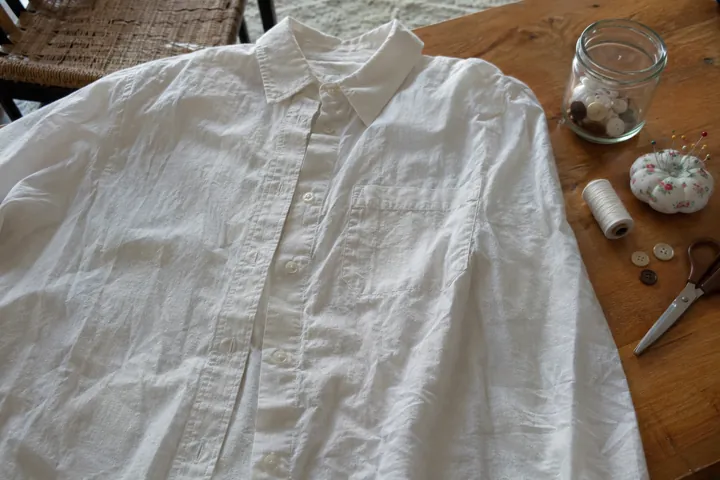
Wear the shirt over the underlayer you intend to use and let the fabric settle. Start untucked so a tight waistband is not pulling the fronts downward. Fasten the normal buttons, stand comfortably and look at the placket without holding it flat. Record the location of any opening rather than immediately calling the whole shirt too small.
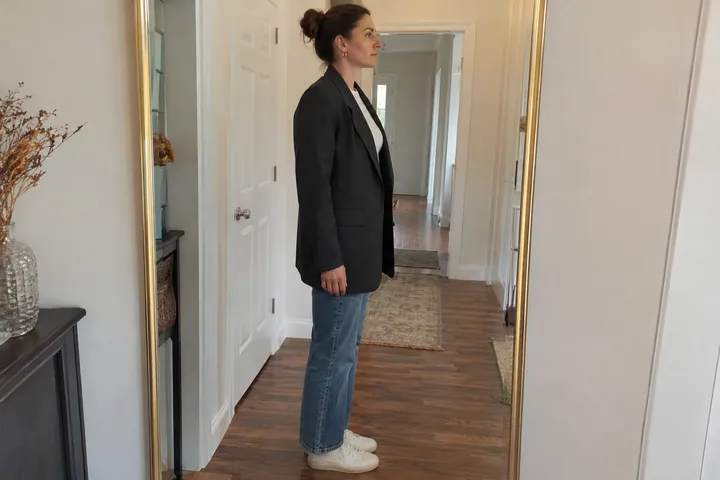
A photograph can preserve that observation, but avoid pulling your shoulders back into a pose you will not maintain. Repeat the check seated and with an ordinary forward reach. Then return to rest. A gap that exists continuously is a different fitting question from one that appears briefly with movement. Neither observation alone identifies the exact pattern adjustment required.
Our blazer fit sequence uses the same principle: assess the layer naturally before asking another garment to cover a problem. A jacket may conceal an opening while leaving the shirt uncomfortable underneath.
Is there tension across the front or space between fastenings?
Look at the fabric around the opening. Is the placket being pulled sideways, with the front strained near a button? Or do the edges sit comfortably at the button positions but separate between them? These are observations to discuss with a fitter, not a remote diagnosis.
| Observation | Controlled comparison | Useful question |
|---|---|---|
| Pulling at rest | Another cut over the same underlayer | Does the front need more room or different shaping? |
| Opening between buttons without obvious strain | Inspect spacing and overlap | Would a discreet additional closure suit this fabric? |
| Gap appears when tucked | Compare untucked without changing posture | Is the waistband or tuck pulling the fronts? |
| Gap appears during a reach | Return to rest, then compare movement in another cut | Is the shirt comfortable for the activities you need? |
Cashmerette's Vernon fitting guide identifies a flat button placket as a fitting feature of that shirt. Use the reference to understand the desired behavior, rather than assuming its sizing system transfers to every ready-to-wear brand.
Should you buy a bigger shirt?
Try it, but compare the whole garment. More front room may help while the collar, shoulders or sleeves become less suitable. Another cut can be a better comparison than repeatedly increasing the size in one pattern. A number on the label does not describe where the manufacturer placed the extra room.
If you sew, Cashmerette's shirt-making resources collect fitting and construction guidance. Its discussion links bust shaping and shirt fit; it does not establish that every opening has one cause. For a purchased shirt, bring the actual garment to an alteration consultation before paying for an assumed fix.
Can an extra snap solve the gap?
A discreet closure may control separation between buttons when the garment otherwise has suitable room. It does not add width. Ask whether the overlap can conceal the fastening, whether the fabric can support it, and whether it will remain comfortable against the underlayer. Do not pierce delicate fabric with repeated trial pins just to force a strained front closed.
Seamwork's reversible-garment construction guide describes concealed closures, including snaps. That illustrates a construction option; deciding where it belongs on an existing shirt still requires inspection. Avoid adhesive or hardware experiments on a favorite garment without checking the material and care guidance.
Blazer fit check
Interactive toolTry the blazer on, then tick each point that is right. Eight points out of eight means the fit works.
Loading the result. The guide above works without this tool.
What should you take to a fitting?
Write a short comparison rather than a requested operation. A fictional note could say: opening at chest level when seated; little pulling while standing; untucking reduces the opening; another shirt in a different cut stays comfortable. That record gives the fitter useful conditions without claiming a single explanation.
Bring the intended underlayer and describe the activities the shirt must allow. Ask about room, overlap and button positioning separately. If the suggested alteration would leave an unwanted mark or require unavailable fabric, compare a different garment. The white shirt styling guide can help you choose an outfit once the shirt is comfortable; styling should follow the fitting decision.
For travel, use the blazer packing method to keep your jacket separate from the shirt assessment. A crease from a suitcase and tension at a fastening are different observations. Recheck the shirt after appropriate care before deciding the closure needs changing.